Toroid Permeability Calculator
A few things to keep in mind when using this tool: The length to diameter ratio of the core can significantly impact the ability to differentiate between materials. Cores with a low length to diameter ratio have a very low effective permeability (µrod) that is nearly indistinguishable between material grades. A trick to evaluate a rod type core that has a low length to diameter ratio is to take several of them placed end to end and test them as one longer rod. The air gaps between the cores will have a relatively insignificant impact on the effective permeability given that the majority of the magnetic field is not contained within the core. Coverage of a coil over a rod is an important factor as well. Getting a complete coverage of the rod will yield a lower inductance modifier (K) and therefor a higher inductance making distinguishing between different materials easier.
Outer Diameter in mm
Inner Diameter in mm
Height in mm
Number of Turns
Series Inductance in microhenries
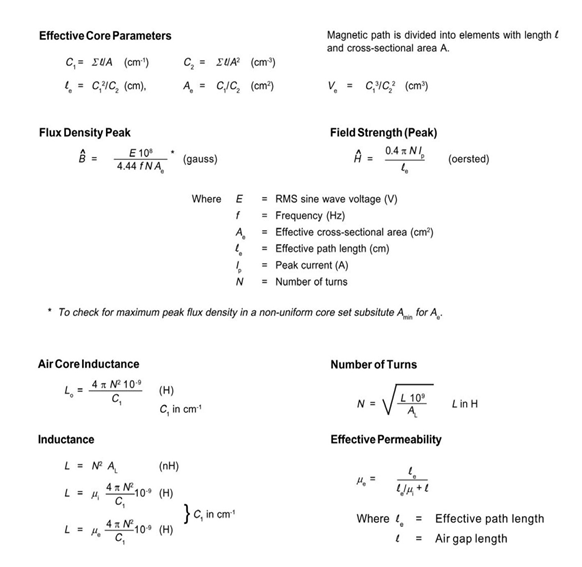
C1 in cm-1
C2 in cm-3
Le in mm
Ae in mm2
Ve in mm3
Lo in nanohenries
Initial Permeability
| Outer Diameter in mm | |
| Inner Diameter in mm | |
| Height in mm | |
| Number of Turns | |
| Series Inductance in microhenries | |
| C1 in cm-1 | |
| C2 in cm-3 | |
| Le in mm | |
| Ae in mm2 | |
| Ve in mm3 | |
| Lo in nanohenries | |
| Initial Permeability |